


From Plate to Palate: 10 Classic Meghalaya Food Experiences
Aug 28th, 2023


Log in to your Account
Share


There are cities you visit by car, cities you navigate by metro, bus or taxi and then there are cities you discover one step at a time. Gangtok belongs to the last category.
Perched along the slopes of the Eastern Himalayas, Sikkim’s capital is not a city that reveals itself all at once. You experience it gradually, maybe while walking along MG Marg, climbing a flight of stairs towards Ridge Park, wandering through the many shops of Lal Bazaar, stopping for Aloo Chewra or turning into an insignificant bend or pausing at a viewpoint where the mountains suddenly appear between buildings and livewires.
Gangtok is hillyscape and has many slopes and equally numerous staircases. Your legs will know about it !! But somehow, that is part of its charm.
What makes Gangtok special is not simply that you can walk around it, it is that walking is one of the best ways to experience and understand the city.
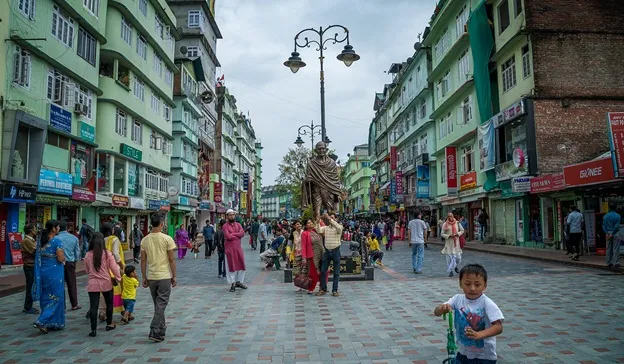
Gangtok's central areas are relatively compact, with markets, cafés, public spaces and many of its everyday attractions within walking distance of each other.
The city's most famous pedestrian square, MG Marg, is at the heart of this experience.
With no traffic rushing through or constant honking, there are instead benches, shops, cafés, people meeting friends, locals going about their daily lives and travellers simply sitting and watching the city go by. It is quite easy to forget that you are in a busy state capital and that is the whole point.
A good public space doesn't always ask you to buy, consume or spend your money on something or to be somewhere and pay for it. Sometimes, it simply gives you somewhere to be.
There is another reason walking in Gangtok feels different. The landscape is never too far away, infact you are always surrounded by it. A short flight of stairs can take you from a busy market to a quiet neighbourhood. A turn in the road can reveal layers of green hills.
Look up from a street and the sky seems much bigger than it did a moment ago. Gangtok's elevation means that even ordinary city walks come with a majestic Himalayan backdrop. You don't have to schedule a viewpoint, it just finds you !!
Yes, Gangtok does have staircases and a lot of them. Let's not romanticise that.
Walking here means slopes, uneven stretches and plenty of uphill and downhill movement. A five-minute distance on Google Maps can actually feel like a small expedition.
But these stairways are also part of the city's character. They connect different levels of settlements and take you away from the main roads into neighbourhoods at their own pace.
One quick walk around Gangtok and you will notice something that is perhaps more important than any tourist attraction. There are women everywhere !!
At shops and cafés, offices and schools. Some running businesses, working in hospitality, walking the lanes, working in government and public institutions, managing households while also building careers and businesses, participating in community life and making decisions etc.
A city feels different when women are not merely present in public spaces but are active participants in shaping them and this visibility matters.
An average Tuesday morning at MG Marg will see a number of smartly dressed working women across all ages shopping for the latest shoes and clothes before heading into work.
Sikkim has a strong tradition of women participating in economic and social life, and women can be seen across professions and sectors. From entrepreneurs and hospitality professionals to educators, government employees, drivers, shopkeepers, artists and community leaders, women's work is an everyday part of life here.
For a traveller, this is not something that needs to be packaged as an attraction. It is simply something you notice and perhaps that is the more meaningful measure of an inclusive destination.
Safety is difficult to measure through a single statistic.For women travellers especially, it is often about something more instinctive.
Can I walk around without constantly calculating the risk? Can I stop at a café alone?
Can I walk through a market in the evening? Can I ask for directions without feeling uncomfortable? Can I explore a neighbourhood without feeling like I am occupying a space that wasn't meant for me?
Gangtok has a reputation for being a relatively safe and welcoming destination, and the presence of women in public spaces at different times of day and across different aspects of society contributes to that sense of normalcy.
Of course, no destination should be treated as completely risk-free. Travellers should always exercise common sense, particularly on quieter roads, late at night and when travelling alone.
But safety is not only about the absence of danger. It is also about the freedom to participate in public life.
And that is where Gangtok has an important story to tell about being one of India’s most safest walkable cities where one can get by without the worry of someone walking or harassing you.
Some of the most interesting things about a place are the things nobody advertises. You see women running shops, buying or selling goods and even liquor, which is quite uncommon in India. You see women working in tourism; women behind reception desks, in offices, classrooms and public institutions and meet women entrepreneurs building businesses of their own.
You see men and women sharing equal responsibilities both at home and at work.
Not everything is perfect, and Sikkim like everywhere else has its own social challenges and inequalities.
But the everyday visibility of women in professional and public life is part of what makes the social landscape of Gangtok interesting.
Equality doesn't always arrive as a slogan. Most often it looks like a woman opening her own thrift shop in the morning. A woman tax driver dropping you off at your stop, someone managing her homestay bookings or a corporate girlie working from home.
These small acts within the community create a sense of security and safety that makes walking around the city as natural and anxiety free as the environment it is nestled in.
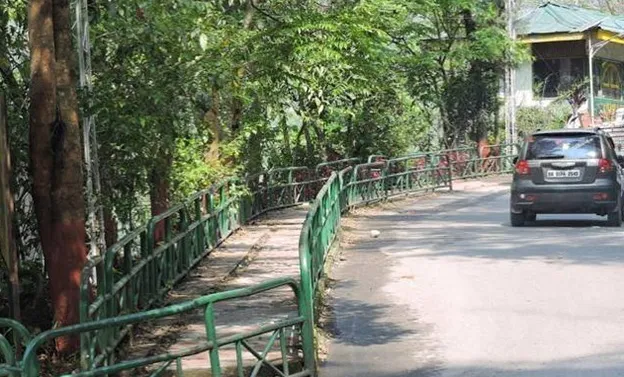
Then there is the weather. Gangtok's temperate Himalayan climate is another quiet reason why the city lends itself so well to walking. For much of the year, temperatures are comfortable enough to explore the city without the intense heat that can make walking through many Indian cities exhausting. Summers are generally mild, while spring and autumn bring particularly pleasant conditions for spending time outdoors with frequent showers in the late afternoons.
Even in winter, when the air gets distinctly cooler, a sunny afternoon walk through the city can be wonderfully refreshing. The monsoon is a different story as Sikkim receives substantial rainfall, and Gangtok's hills become lush and vibrant. Walking requires a little more caution but the combination of cooler temperatures, clean mountain air and low urban pollution makes moving around on foot, umbrella in hand, a considerably more enjoyable experience.
There is also something about the air here when you are walking at an altitude, surrounded by misty hills and greenery rather than a dense urban jungle and that is one of Gangtok's greatest luxuries. A city where the weather often invites you to step outside rather than escape indoors.
When we talk about a walkable city, we usually talk about infrastructure. Footpaths, pedestrian zones, street crossings, manageable traffic, accessibility etc
But maybe there is another layer to walkability. A city is truly enjoyable to walk through when people feel comfortable occupying its public spaces and that includes women.
It includes older people, children, visitors, the people who work there every day and it includes the local communities whose lives existed here long before the destination became a tourist attraction.
Seen this way, walkability is not simply about getting from Point A to Point B. It is about how a city makes you feel while you're getting there.
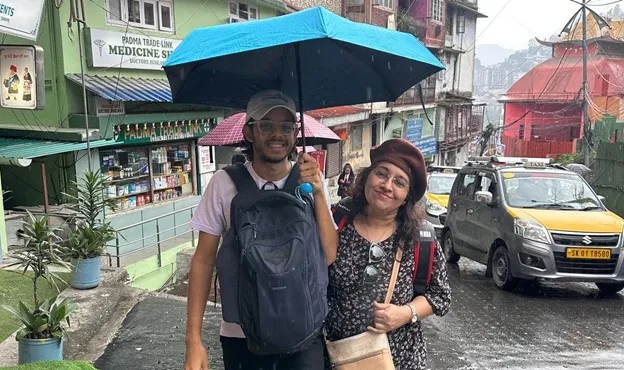
Walkability isn't just about having beautiful streets. It also depends on whether a city makes pedestrians feel that they belong there.
Gangtok does this through something quite simple. It makes space for people on foot.
Across much of the city; footpaths, pedestrian walkways and stairways connect different parts of the urban landscape. Where busy roads need to be crossed, pedestrian overbridges and designated crossing points help people navigate traffic without having to compete with vehicles.
For a hill city built on steep slopes and narrow roads, this matters.One does not have to constantly step onto the road and negotiate their way around moving traffic. There is a greater sense that the pedestrian is part of the city's planning and not an afterthought.
Also there is the traffic.
Gangtok's disciplined traffic culture, by far one of the best all over India, adds another layer to the walking experience. Drivers generally follow lane discipline and traffic signals, with designated stops and there is noticeably no aggressive honking and chaotic overtaking that can make walking through any other busy Indian city quite stressful.
Even something as ordinary as crossing a road feels more orderly. People generally use designated crossings rather than spilling unpredictably into traffic. And most importantly, the horn isn't constantly competing with the sound of the city.
In a place where walking is already made challenging by slopes and altitude, not having to constantly watch out for chaotic traffic makes a considerable difference. It is one of those things you may not notice immediately until you leave Gangtok. Then you realise how much quieter, calmer and more comfortable a city can feel when pedestrians and vehicles share the road with a little more discipline.
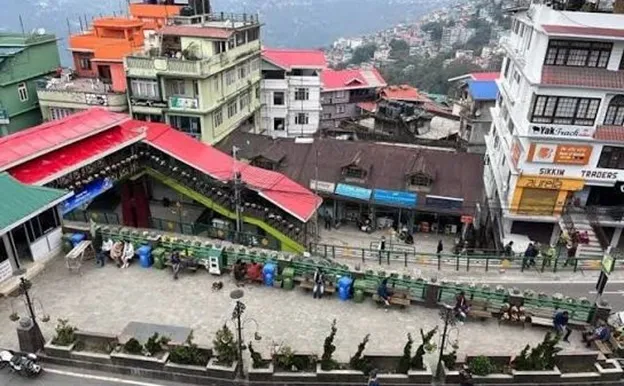
Infrastructure can create a pedestrian-friendly city. But civic behaviour sustains it. Clean public spaces, respect for traffic rules, designated pedestrian areas, no honking and a general awareness of shared public spaces all contribute to making Gangtok feel different.
This is why walkability in Gangtok isn't simply about the distance between two attractions. It is about the entire experience of moving through the city.
The footpath, the crossing, the traffic light, the overbridge, the quiet street and the people who use them responsibly; all become part of the walk.
We wouldn't claim that as an official title.There are plenty of Indian cities doing remarkable things for pedestrians, public spaces and sustainable urban mobility.
But as a hill city with its own challenges of navigation, Gangtok makes a compelling case. It brings together pedestrian friendly public spaces, a wellness park, a relatively compact city centre which is vehicle free, clean surroundings, slower streets, Himalayan vistas and an everyday social environment where women are visible and active across public and professional life.
Most importantly, Gangtok encourages you to slow down and that is what makes it walkable in the first place. Because when you walk through a city, you don't just see its landmarks. You see its people, you notice how they live, who occupies its streets, who runs its businesses, who makes its decisions, who sits in its cafés, who walks home after work.
When you walk through Gangtok, you begin to understand that the city's charm isn't only in its mountains. It is in the way life unfolds between them.
So the next time you're in the capital, put on your comfortable shoes.
Leave some space in your itinerary and don't book a cab for every short distance.
Written by Prerna
Prerna, a seasoned travel & hospitality expert, isn't just a writer – she's a curator of experiences. Leading OurGuest's operations at The Barfung Retreat, she leverages her extensive background at Taj, Hyatt, ITC, and more. A Master's graduate in English Literature, Prerna's passion for storytelling is fueled by her childhood spent traversing India with her police officer father. Fluent in Bengali, Hindi, English, and Nepali, she fosters genuine connections across cultures. Join Prerna as she unveils the hidden gems and vibrant soul of Northeast India, one captivating story at a time.
For a customized Sikkim Tour experience you can contact us at +91-7669503993 or email to contact@ourguest.in


