Your Complete Guide to Sandakphu Trek
Mar 15th, 2024


Log in to your Account
Share


Tucked away in the West Jaintia Hills of Meghalaya, about 58 km from Shillong, is a village called Larnai. Home to one of Northeast India's oldest and most distinctive handicrafts, the black pottery. No wheel, no machines, just hands, clay, and generations of inherited skill.
If your itinerary includes destinations around the Jaintia Hills, this is one stop worth building an entire experience around.
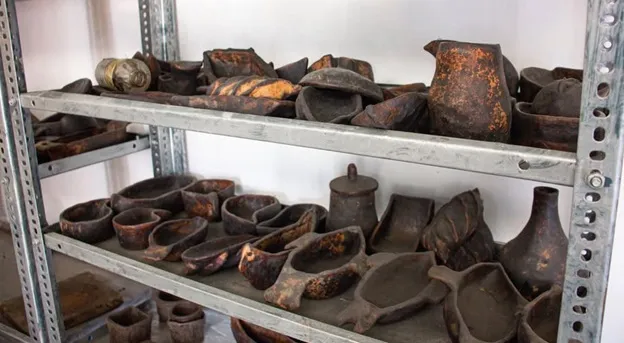
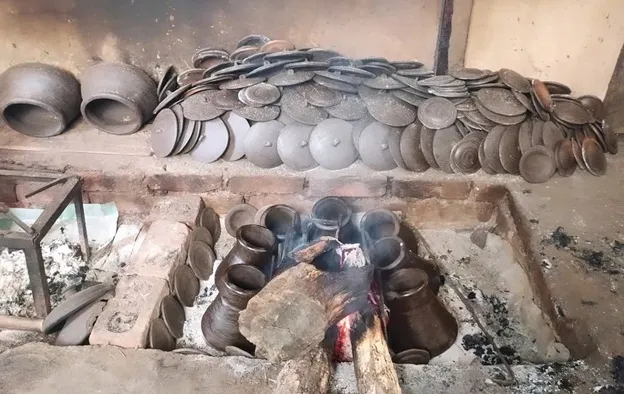
The colour comes from the raw material, not a glaze. Artisans use a rare black clay found only in the Sung Valley, mixed with serpentine stone. The clay is softened, pounded by hand with a pestle until it turns into a dough-like consistency, then shaped entirely by hand on a flat wooden surface. There is no potter's wheel involved at any stage. Once a piece takes form, it dries for two to three days before being fired in a wood furnace, which gives it its signature matte-black, smoky finish.
This is a matrilineal craft passed down in a matrilineal society. Only the women of Larnai make the pots; the men typically go out to source the black clay and serpentine stone from the hills. Skills move from mother to daughter in an unbroken process across generations and is one of the last places in the region where the craft survives almost entirely without machinery.
Long before it became a collector's item, Larnai pottery was purely functional. Its heat resistance and durability made it a household staple for cooking and storing food across the Khasi-Jaintia Hills, with Jowai as the main market. Today it's equally prized as an understated, sculptural home decor be it vases, mugs , bowls etc, each piece is slightly different because it is shaped entirely by hand.
Larnai black pottery now carries India's Geographical Indication (GI) tag, formal recognition of its regional and cultural uniqueness. The state government has also run skill-development and market-access programmes for Larnai's artisans in recent years, including exposure trips and digital marketing training, to help the craft reach beyond local markets.
That said, the artisans still face real hurdles like durable road connectivity into the village, fulfilling and delivering larger orders, and the process itself is slow and entirely manual. Every purchase or visit genuinely supports the continuation of a craft that could otherwise fade.
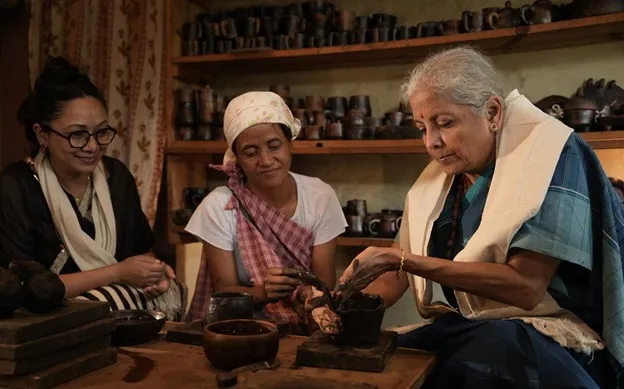
Larnai's traditional pottery received national attention in June 2026, when Union Finance Minister Nirmala Sitharaman visited the village during her Meghalaya tour.
During her visit on 20 June, Sitharaman interacted with local artisans and witnessed a live demonstration of the traditional black clay pottery-making process, including clay preparation, hand-moulding and engraving. She also tried her hand at moulding the clay herself under the guidance of the artisans.
The visit highlighted the cultural and livelihood significance of Larnai's GI-recognised pottery. Sitharaman emphasised the importance of preserving traditional skills and expanding market opportunities for local artisans. She also visited an exhibition featuring Meghalaya's GI-tagged products, including Larnai Black Clay Pottery.
Her visit brought additional attention to Larnai as a destination where travellers can experience a living craft tradition at its source, rather than simply seeing the finished products in a shop.
https://www.pib.gov.in/PressReleasePage.aspx
Getting there: ~58 km / 2–2.5 hours from Shillong by road. The nearest town, Ummulong, is about 4 km away with shared taxis.
Best time to visit: October to March, when drier roads make the village easier to reach.
What to expect on a day visit : Lasting 4 to 5 hours (roughly 10 am–4 pm) where local artisans walk you through the history and process of black pottery-making, alongside a chance to try local Khasi and Pnar delicacies.
Take home: A hand-shaped piece that's genuinely one-of-a-kind — no two pots are ever identical.
Larnai sits close to Jowai, the West Jaintia Hills' main town, so it pairs easily with a day or two exploring the rest of the district:
Jowai (~20 km): The district headquarters and the region's main market town — a good base for meals, supplies, and onward transport.
Nartiang Monoliths (~30–35 km): Asia's largest collection of megalithic monoliths, along with the Nartiang Durga Temple and the ruins of the Jaintia king's former summer palace.
Krang Suri Falls (~90 km from Shillong, roughly a similar range from Larnai via Jowai): A striking turquoise-blue waterfall with a natural pool for swimming — one of the most photographed spots in the Jaintia Hills.
Thadlaskein Lake (near Jowai): A serene, legend-steeped lake popular for a quiet picnic stop or short boat ride.
Syntu Ksiar: A peaceful riverside park along the Myntdu River in Jowai, good for an easy evening walk.
Krem Liat Prah: One of India's longest limestone cave systems, for travellers who want to add a caving element to the trip.
Most of these can be combined into a relaxed 2–3 day loop with Jowai as the anchor point, alongside the Larnai pottery visit.
Where exactly is Larnai village?
Larnai is in the West Jaintia Hills District of Meghalaya, about 58 km (2–2.5 hours by road) from Shillong, and roughly 20 km from Jowai, the nearest town.
What makes Larnai pottery "black"?
The colour comes from a rare black clay found only in the Sung Valley, mixed with serpentine stone, and finished with a wood-fired process that gives it its distinctive smoky-black, matte look with no dyes or glazes used.
Is it made on a potter's wheel?
No. Larnai pottery is entirely hand-shaped on a flat wooden surface — one of the few pottery traditions in India still practised without a wheel or machinery.
Who makes Larnai black pottery?
It's traditionally a craft passed down through women, mother to daughter, for generations. Men in the community typically source the raw black clay and serpentine stone from the surrounding hills.
Can visitors watch or take part in the pottery-making process?
Yes. Larnai offers a day-visit experience (around 10 am–4 pm) where local artisans walk visitors through the history and process of black pottery-making, along with a taste of local Khasi and Pnar food.
When is the best time to visit Larnai village?
October to March, when drier weather makes the village roads easier to travel.
Does Larnai pottery have any official recognition?
Yes, iit carries India's Geographical Indication (GI) tag, which formally recognises its unique regional origin and traditional technique.
Is Larnai pottery just for pots and cooking?
It started as functional cookware, valued for its heat resistance and durability, but today artisans also make decorative pieces like vases, bowls, mugs etc popular as home décor, with each piece naturally one-of-a-kind.
Can I buy Larnai pottery outside the village?
Some pieces are available through select handicraft retailers and online stores, though buying directly from Larnai (or via the experience visit) puts more value directly into artisans' hands.
Written by Prerna
Prerna, a seasoned travel & hospitality expert, isn't just a writer – she's a curator of experiences. Leading OurGuest's operations at The Barfung Retreat, she leverages her extensive background at Taj, Hyatt, ITC, and more. A Master's graduate in English Literature, Prerna's passion for storytelling is fueled by her childhood spent traversing India with her police officer father. Fluent in Bengali, Hindi, English, and Nepali, she fosters genuine connections across cultures. Join Prerna as she unveils the hidden gems and vibrant soul of Northeast India, one captivating story at a time.
For a customized Offbeat Meghalaya experience you can contact us at +91-7669503993 or email to contact@ourguest.in